A kettlebell workout for beginners at home needs just one kettlebell, about 20 minutes and three non-consecutive days a week. Learn six moves in a set order: deadlift, goblet squat, swing, row, press and carry. Use a bell light enough that your form stays clean, and end every set when form slips.
This guide gives you a 4-week plan with exercises, sets, reps and rest times for each session. You’ll also get a simple method to choose your bell weight in kg, a hip-hinge check before you start swinging, and the common form mistakes for each move. It works as a calm restart after Diwali, with no punishment workouts.
Key Takeaways
- One kettlebell, about 20 minutes and three non-consecutive days a week are enough to start training safely at home.
- Learn the six moves in order (deadlift, goblet squat, swing, row, press, carry), and check your hip hinge before adding swings.
- Choose a light bell with the 10-rep test and move up only when every rep is clean from start to finish.
- Stop a set when your form breaks, not when you hit a rep target, and never double up to catch up after a missed day.
- Judge your first month by consistency and technique, not the scale, and see a doctor first if you have pain or a medical condition.
Table of Contents
- Your Kettlebell Workout for Beginners at Home: The Short Answer
- Is a Single Kettlebell Enough? What You Need Before You Start
- Kettlebell Weight for Beginners: What Size Should You Buy (in kg)?
- Warm-Up: The 5-Minute Routine Before Every Session
- Kettlebell Exercises for Beginners: The 6 Moves to Learn First
- Are You Ready to Swing? A Quick Hip-Hinge Check
- Your 20-Minute Full Body Kettlebell Workout (Session Template)
- 4-Week Kettlebell Workout Plan for Beginners (Week-by-Week)
- Beginner Kettlebell Tips for Women, Men, Desk Workers and Small Homes
- Your Next Step: Start This Week
- Frequently Asked Questions
- Sources
Your Kettlebell Workout for Beginners at Home: The Short Answer
Train three days a week, such as Monday, Wednesday and Friday. Each session is about 20 minutes: a 5-minute warm-up, then roughly 15 minutes of work with one kettlebell. Start with a light bell, learn the hip hinge first, and add moves slowly over four weeks.
The plan at a glance:
- Frequency: 2–3 sessions a week, never on back-to-back days at the start.
- Session length: about 20 minutes, including warm-up.
- Moves: deadlift, goblet squat, swing, one-arm row, press and suitcase carry, added gradually over four weeks.
- Bell weight: a light bell chosen with the 10-rep test in the next sections (many beginners start somewhere between 4 and 12 kg).
- Rest: 45–90 seconds between sets while you are learning (shorter for rows and carries).
- Golden rule: stop the set when form breaks, not when you hit a target number.
Do short sessions really count?
Yes. The WHO recommends that adults aged 18–64 do muscle-strengthening activities involving all major muscle groups on 2 or more days a week, a point it repeats in its regional physical activity guidance. Two or three full-body kettlebell sessions, done at a moderate or greater effort, can meet that guideline.
A low-pressure restart
If Diwali pulled you off your routine, Week 1 is deliberately easy. There are no crash diets, no “make up for the mithai” workouts and no fast-result promises. Strength, energy and posture improve gradually, and the pace differs from person to person.
This is general fitness information, not medical advice. If you have a medical condition, ongoing pain, or you’re returning after a long break, check with a doctor first.
[OWNER: add one line on why you started with kettlebells and your own restart story after a break such as Diwali.]

Is a Single Kettlebell Enough? What You Need Before You Start
Yes. One kettlebell can train your legs, hips, back, shoulders and core, which is all you need for the first few months. You don’t need a rack, a bench or a full set of weights.
Why one bell works for beginners
The six starter moves all use the same weight. Deadlifts, squats and swings are leg-and-hip moves where a single bell is usually challenging enough. Rows, presses and carries work one arm at a time, so the same bell feels heavier there. You may need a lighter bell for the press than for the deadlift. You’ll rarely feel the need for a second bell in the first month.
Kettlebell vs dumbbell for beginners
Both are fine, and the better choice depends on what you’ll do with it.
- Kettlebell: the handle sits away from the weight, which suits swings and hinge-style moves, and goblet squats feel natural with a bell held at the chest.
- Dumbbell: works well for presses and rows, and adjustable sets make it easy to change weight in small steps.
If your main goal is a short, full-body routine built around the hinge, a kettlebell is the simpler single purchase.
Setup basics
- Footwear: stable, closed-toe shoes with a flat sole. Avoid socks on tiles.
- Mat: a thick rubber mat or board protects tiles from the bell and gives you grip. Use a separate exercise mat for glute bridges and any floor work.
- Space: clear about 2 m × 2 m. Check for ceiling fans, low lights and furniture before any overhead move.
- Heat and humidity: keep a towel for sweaty hands, water nearby and a fan on (pointed away from the bell’s path).
- Timing: a 20-minute slot before or after office hours is enough. Pick the one you’ll actually keep.
One bell and a mat are the only purchases to consider. [OWNER: add affiliate links for a kettlebell and a mat, and confirm current Indian options and prices, such as Decathlon India, Amazon India or local stores.]
[OWNER: add which kettlebell(s) you own (kg, brand, where bought, rough price in INR) and how long you have used them.]
[OWNER: add where you train at home (flat, balcony, hall) and how you handle floor protection and noise.]
Kettlebell Weight for Beginners: What Size Should You Buy (in kg)?
Many beginners start somewhere between 4 and 12 kg, but there’s no single right answer. Heavier is not better at this stage, because the first weeks are about learning the movement. Use the 10-rep test below to pick your size.
Why the advice disagrees
Different sources give different ranges, and retailer and specialist advice tends to run higher than the ACE-based figures.
| Source | Men | Women | Note |
|---|---|---|---|
| Healthline (citing ACE) | 7–11 kg | 4–7 kg | Listed as 15–25 lb and 8–15 lb |
| Crunch India | 8–12 kg | 4–8 kg | Full-body routine 2–3 times a week |
| Titan Fitness | 12–16 kg | 8–12 kg | Go a little lighter if unsure |
| Onnit | 8 kg (if not new to weights) | 6 kg (if new to weight training) | Bells usually go up in 4 kg steps; men tend to overestimate |
Treat these as ranges, not rules. Your starting point depends on your strength, your experience and how well you hinge.
The 10-rep test
- Pick a bell you think is slightly light.
- Do 10 deadlifts, then rest 60–90 seconds.
- Do 10 goblet squats with clean form.
- The last 2 reps feel slow but your form holds: the weight is right.
- Form breaks by rep 6: go lighter.
- It feels easy throughout: you may be ready for the next size up.
When to go up, and why to buy for 2–3 months
Move up only when you can do every rep with consistent form from start to finish, a rule echoed by Gold’s Gym. Stay on one weight until the movement is mastered.
Kettlebells come in fixed steps, so buy for the next 2–3 months, not for the “future you”. If you’re unsure between two sizes, take the lighter one. A bell that’s slightly easy is still useful for rows, presses and carries, while one that’s too heavy can wreck your swing and hinge.
An adjustable kettlebell is an option if you expect to change weight often. [OWNER: add your honest view on adjustable vs fixed cast-iron bells, only if you have used both.] [OWNER: confirm current Indian options and prices, and add affiliate links.]
For a deeper look at choosing a size, see [OWNER: link to the weight-choice spoke article once published, and confirm its URL].
Warm-Up: The 5-Minute Routine Before Every Session
Do you really need a warm-up?
Yes. Hours at a desk leave hips and shoulders stiff, and a few minutes of movement helps you hinge and squat with better form. Healthline suggests 5-10 minutes. Five is enough for a 20-minute session.
The 5-minute warm-up
Move through these with no rest between them, apart from a few seconds to reset.
- Hip hinge drill: 8 slow reps, hands on hips, pushing your hips back.
- Bodyweight squat: 10 reps, heels down.
- Glute bridge: 10 reps, squeezing at the top.
- Arm circles: 10 in each direction.
- Halo with a light bell: 5 in each direction. Skip it if it bothers your shoulders.
- One light practice set: 6 easy deadlifts with your training bell.
Common mistake: rushing through the warm-up or skipping it on “no time” days. Even 3 minutes is better than none. [OWNER: add your own warm-up habit, and whether you ever skipped it.]
Kettlebell Exercises for Beginners: The 6 Moves to Learn First
One bell can train your whole body with just six moves. Learn them in this order: hinge first, then squat, then swing. Healthline, citing ACE, calls the deadlift a good first move, because the hinge underpins the swing.
The rep ranges below sit mostly at 8-12. A US guidelines text describes one set of 8-12 reps per exercise as effective, with two or three sets possibly better.
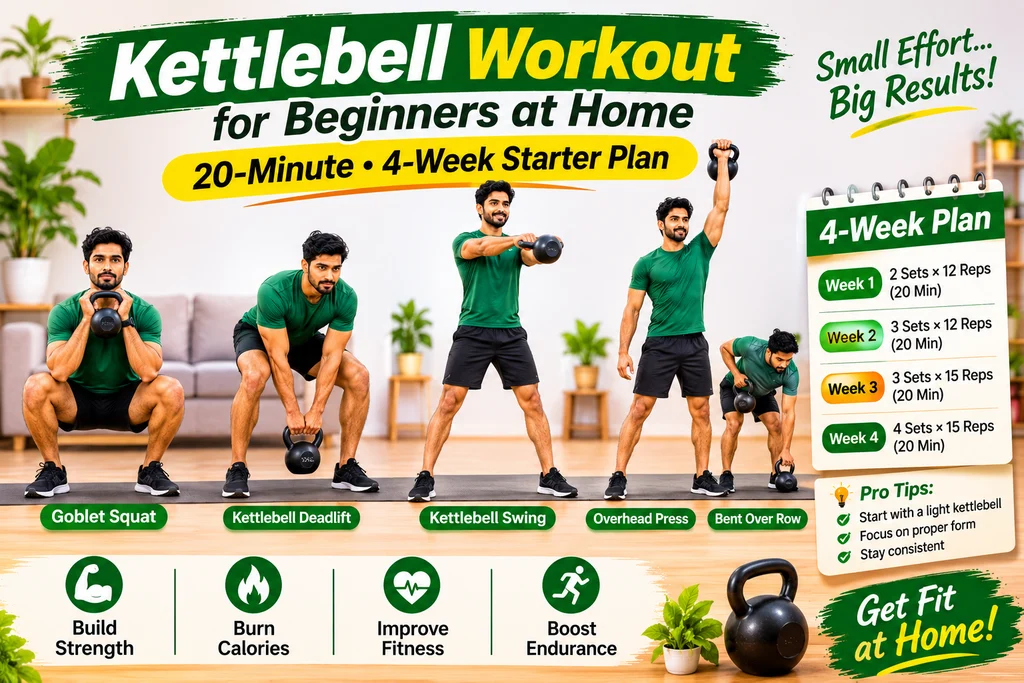
1. Kettlebell deadlift (hip hinge)
Trains: hamstrings, glutes and back.
- Stand with the bell between your feet, shoulder-width apart.
- Push your hips back and reach down with a flat back.
- Grip the handle and brace your core.
- Drive your feet into the floor and stand tall.
Start with: 2-3 sets of 8-12 reps, resting 60 seconds.
Common mistakes: squatting the movement, rounding the back, letting the bell drift forward.
Easier option: raise the bell on a stack of sturdy books or a block.
2. Goblet squat
Trains: legs, glutes and core.
- Hold the bell by the horns against your chest, elbows down.
- Sit down between your knees with your chest tall.
- Keep your heels flat on the floor.
- Stand up by pushing the floor away.
Start with: 2-3 sets of 8-10 reps, resting 60 seconds.
Common mistakes: knees caving in, heels lifting, leaning forward, holding your breath.
Easier option: squat to a chair or do bodyweight squats.
3. Kettlebell swing
Trains: glutes, hamstrings and your heart rate.
- Stand with the bell a foot in front of you.
- Hinge, then “hike” the bell back between your legs.
- Snap your hips forward and let the bell float to chest height.
- Squeeze your glutes at the top and let the bell fall back as you hinge.
Start with: 3-4 sets of 6-10 reps, resting 60-90 seconds.
Common mistakes: ACE names two: squatting instead of hinging, and lifting with the arms and shoulders instead of your hips. Coach adds rounded shoulders, and advises squeezing your glutes at the top to avoid overextending your lower back.
Easier option: deadstop swings, resetting the bell on the floor each rep. Check the hinge test in the next section before you start.
4. One-arm row
Trains: upper back and arms, which helps offset desk posture.
- Hinge with one hand on your thigh or a sturdy bench.
- Keep your back flat and the bell hanging below your shoulder.
- Pull your elbow toward your hip.
- Lower under control.
Start with: 2-3 sets of 8-10 reps per arm, resting 45-60 seconds.
Common mistakes: twisting your torso, shrugging toward your ear.
5. Shoulder press
Trains: shoulders and arms.
- Lift the bell to your shoulder with both hands, then hold it in one hand with your wrist straight.
- Squeeze your glutes and keep your ribs down.
- Press straight up until your arm is by your ear.
- Lower to your shoulder.
Start with: 2-3 sets of 5-8 reps per side, resting 60 seconds.
Common mistakes: leaning back, flaring your elbow, bending your wrist.
Easier option: use a lighter bell. The press often needs a smaller one than the deadlift.
6. Suitcase carry
Trains: grip, core and posture.
- Hold the bell at your side, standing tall.
- Walk slowly with your shoulders level.
- Turn around and repeat on the other side.
Start with: 2 rounds of 20-30 seconds per side, resting 30-45 seconds.
Common mistake: tilting toward the bell.
Quick reference table
| Move | Sets x reps | Rest | Key cue |
|---|---|---|---|
| Deadlift | 2-3 x 8-12 | 60 s | Hips back, flat back |
| Goblet squat | 2-3 x 8-10 | 60 s | Chest tall, heels down |
| Swing | 3-4 x 6-10 | 60-90 s | Hinge, don’t squat |
| One-arm row | 2-3 x 8-10 per arm | 45-60 s | Elbow to hip |
| Press | 2-3 x 5-8 per side | 60 s | Glutes tight, ribs down |
| Suitcase carry | 2 x 20-30 s per side | 30-45 s | Stay tall |
Safety basics for every move
- Breathe through each rep.
- Keep a firm grip and wear stable, closed shoes.
- Stop a set when your form breaks.
- Stop immediately on sudden, sharp pain.
[OWNER: add the mistakes you made as a beginner, such as swinging by squatting, using a bell that was too heavy or too light, skipping the warm-up, or doing too much too soon.]
Are You Ready to Swing? A Quick Hip-Hinge Check
Before you add swings, check that you can hinge. The swing is a hip movement, and learners most often squat it or lift the bell with their arms. This three-point test takes about five minutes.
The 3-point pass/fail test
- Wall tap: Stand one step from a wall, facing away. Push your hips back to touch it with your knees only slightly bent and your back flat.
- 10 clean deadlifts: Use your training bell. Your back should not round and the bell should stay close to your legs.
- Video check: Film yourself from the side, or hold a broomstick along your spine. Your head, upper back and hips should stay in one line.
Pass all three and you can start swings in Week 2. Miss one and you aren’t behind. You just need a little more hinge practice.
If you don’t pass yet
- Stay on deadlifts for another week.
- Raise the bell on a block or a stack of books to shorten the range.
- Try a lighter bell.
- Do deadstop swings, setting the bell down behind your legs after every rep. Each rep starts fresh, so there is no rushing.
How to know your swing is correct
- You feel it in your hamstrings and glutes, not your lower back or arms.
- Your arms stay loose and the bell “floats” to about chest height.
- You finish standing tall with your glutes squeezed, not leaning back.
- The movement looks like a hinge on video, not a squat.
If two or more of these feel off, put the bell down and go back to deadlifts. Quality reps come first.
Your 20-Minute Full Body Kettlebell Workout (Session Template)
This is a simple template to repeat three times a week: a warm-up, about 15 minutes of work and an optional short stretch. It uses the moves you have already learned.
Minute-by-minute layout
| Time | What you do |
|---|---|
| 0-5 min | Warm-up routine |
| 5-12 min | Round 1 of Workout A (below) |
| 12-19 min | Round 2 of Workout A |
| 19-20 min | Optional easy stretch of hips and chest |
Workout A:
- Deadlift: 10 reps
- Goblet squat: 8-10 reps
- One-arm row: 8 per arm
- Press: 5-8 per side
- Suitcase carry: 20-30 seconds per side
Rest 45-60 seconds between sets and 60-90 seconds after the heavier moves. This is a little longer than some programmes use, and it suits form practice. Swings join this template in the 4-week plan below.
Rep-based or timed intervals?
Some programmes use timed rounds, such as 40 seconds of work and 20 seconds of rest. They can work later, once your technique is steady. While you are learning, count reps and rest fully. A timer shouldn’t push you to rush.
The stop-the-set rule
End a set when your form breaks, not when the timer or rep target says so. A rounded back or a drifting bell means stop, rest and try again.
A 10-minute minimum day
On a packed day, do a shorter version: 2 rounds of 8 deadlifts, 8 goblet squats and 6 rows per arm, with minimal rest. It keeps the habit going, but it skips the press and carry, so use it only now and then. TheWHO muscle-strengthening guidelineasks for all major muscle groups on 2 or more days a week, so full 20-minute sessions are the main plan.
[OWNER: add your go-to 10-minute minimum session.]
4-Week Kettlebell Workout Plan for Beginners (Week-by-Week)
Here is the whole first month on one page. Train on three non-consecutive days, such as Monday, Wednesday and Friday. Use the other days for rest or an easy walk. Every session starts with the 5-minute warm-up.
| Week | Moves | Sets x reps | Rest | Approx. time (with warm-up) |
|---|---|---|---|---|
| 1 | Deadlift, goblet squat, glute bridge | 2 rounds x 8 reps each | 60-90 sec | 15-20 min |
| 2 | Add one-arm row and deadstop swings | Deadlift, squat, row: 2-3 rounds. Swings: 3 sets of 6-8 | 60-90 sec | 20 min |
| 3 | Add press and suitcase carry | 2-3 rounds. Swings: 3 sets of 10 | 45-90 sec | 20-25 min |
| 4 | All 6 moves | 3 rounds if form holds | 45-90 sec | 20-25 min |
Week 1: Learn the hinge and squat
This is the low-pressure restart. Two sessions are fine if you are coming back after Diwali or a long break. Keep the bell light and focus on clean reps, not on getting tired.
Week 2: Add the row and start swings
Add the one-arm row, 8 reps per arm. Start swings only if you passed the hip-hinge check. Reset the bell on the floor after every rep (a deadstop swing), and do three sessions if you feel fine.
Week 3: Build rounds and add the press and carry
Add the press (5-8 per side) and the suitcase carry (20-30 seconds per side). Aim for two to three rounds. Move up to 10 swings per set only if your hips are doing the work, not your arms.
Week 4: Consolidate and test your bell
Run the full six-move circuit, using the session template from the previous section. Try for three rounds, and drop to two if form slips. At the end, repeat the 10-rep test from the weight section and decide whether to move up a bell.
Rules for adding reps, sets or weight
- Add reps first, staying inside the ranges given for each move.
- Add a round next.
- Add weight last, and only when every rep is clean from start to finish. Gold’s Gym gives the same rule.
Missed a day or a week? The restart rule
Missed a day? Just carry on with the next session. Never double up to catch up. Missed a week? Repeat the last week you completed, with fewer rounds or a lighter bell.
Early progress is mostly better technique and confidence with the moves. Strength and energy changes show up gradually and differ from person to person, so judge the month by consistency, not by the scale.
[OWNER: add your real weekly routine: which days, time of day, minutes and exercises.]
[OWNER: add how you handled a missed week.]
Beginner Kettlebell Tips for Women, Men, Desk Workers and Small Homes
Women and men: same plan, different starting bell
The plan is the same for everyone. Only the starting bell differs, so use the weight table and the 10-rep test rather than a rule based on gender. Onnit’s former Chief Fitness Officer notes that men tend to overestimate what they can lift, so a lighter bell is a smart start for anyone.
Desk-job tips: hips, back and shoulders
Long sitting can leave hips and shoulders stiff, which is why the warm-up and hinge drills matter. Start light and stand up for a short walk or stretch between meetings. Stop any set on sharp pain.
This guide is general fitness information, not medical advice or injury rehab. If you have an existing back or shoulder problem, check with a doctor or physiotherapist first.
Apartment-friendly training and noise
- Use a thick mat or rubber flooring, and lower the bell softly instead of dropping it.
- Deadstop swings, where the bell touches the floor each rep, can be noisy. If neighbours are close, swap them for goblet squats, rows and carries on that day.
- Choose sensible hours, such as early morning or a reasonable evening slot.
[OWNER: add where you train (flat, balcony, hall) and how you handle noise and floor protection.]
For more ideas, see our guide to apartment-friendly kettlebell workouts. [OWNER: confirm this spoke exists and add the internal link.]
Fat loss, muscle and how long results take
Kettlebell sessions are one part of the picture. Fat loss also depends on your eating, sleep and daily activity, and no plan can promise a number. [OWNER: link to your nutrition or fat-loss-at-home article if one exists, and confirm the URL.]
For muscle, add reps and weight slowly over time. A separate guide goes deeper on building muscle at home. [OWNER: confirm this spoke exists and add the internal link.]
[OWNER: add your own results so far (strength, energy, weight or waist), the timeframe, and honestly what you did and did not change in your diet.]
Your Next Step: Start This Week
A kettlebell workout for beginners at home needs only one bell, about 20 minutes and three days a week. Start light, learn the hinge first and stop each set when your form breaks. Small, steady sessions add up, and there is no need to punish yourself after the festival season.
Pre-workout checklist
- Pick your bell using the 10-rep test.
- Clear a 2 m x 2 m space with a mat, and check for fans and low ceilings.
- Put three non-consecutive slots in your calendar.
- Start with Week 1, not Week 4.
- Film your hinge from the side to check your back.
If you have a medical condition or pain, or are returning after a long break, speak to a doctor before you begin.
What to read next
- Kettlebell weight for beginners: a deeper guide to choosing your bell. [OWNER: confirm slug and add link.]
- Apartment-friendly kettlebell workouts. [OWNER: confirm slug and add link.]
- Building muscle at home with kettlebells. [OWNER: confirm slug and add link.]
Your one action: do Week 1, Session 1 within the next 48 hours. Keep it easy and finish feeling you could have done more.
Frequently Asked Questions
How many times a week should a beginner do kettlebell workouts?
Two to three times a week is a good start, on non-consecutive days such as Monday, Wednesday and Friday. If you are returning after a long break, two sessions in Week 1 is fine. Use the other days for rest or an easy walk, and add a third session once recovery feels comfortable.
Should I learn the kettlebell swing or the goblet squat first?
Learn the deadlift (hip hinge) and goblet squat first, then add swings. The swing is a hip movement, and most beginners squat it or lift with their arms. Pass the three-point hinge check, then start with deadstop swings in Week 2.
Is a kettlebell better than dumbbells for beginners?
Neither is strictly better. A kettlebell suits swings, hinges and goblet squats, so it is a simple single purchase for a short full-body routine. Dumbbells work well for presses and rows, and adjustable sets let you change weight in small steps. Choose by what you will actually do.
How long does it take to see results from kettlebell training?
It varies from person to person, so there is no fixed timeline. In the first month you will mostly notice better technique, steadier energy and stronger hips. Judge progress by consistency and clean reps rather than the scale, and remember that eating, sleep and daily activity also matter.
Can kettlebell workouts help with fat loss at home?
They can be one useful part of a fat-loss routine, but they are not a guarantee. Results also depend on your eating, sleep and daily movement. Short full-body sessions are easy to repeat consistently, and that consistency matters more than any single workout.
How long should I rest between kettlebell sets?
Rest 60–90 seconds between sets while you are learning, and 45–60 seconds after lighter moves like rows. Carries need only 30–45 seconds. Resting fully helps you keep clean form, so avoid rushing with a timer until your technique is steady.
Do I need a warm-up before a kettlebell workout?
Yes. A 5-minute warm-up loosens hips and shoulders stiffened by desk hours and helps you hinge and squat better. Use hip hinge drills, bodyweight squats, glute bridges, arm circles and a light practice set. Even 3 minutes beats skipping it on a busy day.
Can I do kettlebell workouts in an apartment without disturbing neighbours?
Yes, with a few precautions. Use a thick mat or rubber flooring, lower the bell softly and train at sensible hours. Swings are the noisiest move, so on days when neighbours are close, swap them for goblet squats, rows and carries.
Sources
- Beginner kettlebell workout: 5 exercises from an expert PT
- Kettlebell Workouts for Beginners: Exercises, Benefits, and How to Start
- Full Body Kettlebell Workout Plan for Beginners
- Kettlebell workout for weight loss: 6 full body moves
- Kettlebell Workout Program for Strength and Conditioning
- Beginner Kettlebell Workout Plan With 4 Effective Exercises
- 5 best kettlebell exercises for beginners to build full-body strength, muscle and power at home
- Kettlebell Workout Program